What Is a Slot Canyon?
A slot canyon is a narrow, deep canyon formed by water erosion cutting through sandstone over millions of years. The defining feature is the width-to-depth ratio: slot canyons are often only a few feet wide at the bottom but hundreds of feet deep, with walls that curve and undulate in ways that create dramatic light effects. The name comes from the canyon's appearance from above: a narrow slot cut into the desert rock.
The American Southwest contains the highest concentration of slot canyons in the world. The Navajo Sandstone formation that covers much of the Colorado Plateau (spanning northern Arizona, southern Utah, and parts of Nevada and Colorado) is the geological host for virtually all the famous slot canyons on this list. Flash floods carved them; flash floods remain the primary hazard when visiting them.

Side-by-Side Comparison Table
All prices and policies as of 2026. Guide-required canyons on Navajo Nation land require a licensed Navajo guide with no exceptions.
| Canyon | Location | Access | Difficulty | Price | Duration | Flash Flood Risk | Tripod Allowed | Kid-Friendly |
|---|---|---|---|---|---|---|---|---|
| Upper Antelope | Page, AZ | Guide required | Easy | $80–120 | 1–1.5 hrs | High | No | Yes |
| Lower Antelope | Page, AZ | Guide required | Easy–Moderate | $64–95 | 1–1.5 hrs | High | Some tours | Yes (ladders) |
| Canyon X | Page, AZ | Guide required | Moderate | $79 | 1.5–2 hrs | High | Yes | Yes |
| Mountain Sheep Canyon | Page, AZ | Guide required | Easy–Moderate | ~$50–70 | 1–1.5 hrs | High | Yes | Yes |
| Waterholes Canyon | Page, AZ | Self-guided | Moderate | ~$10–20 | 30–60 min | High | Yes | With caution |
| Wire Pass | Utah (40 mi N) | NPS permit | Easy–Moderate | ~$10 | 1–3 hrs | High | Yes | With caution |
| Buckskin Gulch | Utah (40 mi N) | NPS permit | Strenuous | ~$10–15 | Full day+ | Very high | Yes | No |
| Peek-a-Boo (Kanab) | Utah (120 mi N) | BLM permit | Moderate | ~$6 | 2–4 hrs | Medium | Yes | With caution |
| Spooky Gulch | Utah (120 mi N) | Self-guided | Moderate | Free | 1–2 hrs | Medium | No (too narrow) | No (narrows to 10") |
| The Zion Narrows | Utah (180 mi N) | NPS permit | Moderate–Hard | Free–$16 | Half–full day | High | Yes | With caution |
Prices are per-person for general admission. Guide-required canyons (Navajo Nation) include the guide fee in the listed price. NPS/BLM permit fees vary seasonally. Data last verified July 2026.
Page, Arizona Slot Canyons
Page is the slot canyon capital of the American Southwest. Within 15 miles of the city limits, there are at least five distinct slot canyons open to visitors, more than anywhere else on the Colorado Plateau. All the canyons on Navajo Nation land (which covers most of the area around Page) require a licensed Navajo guide. This is a legal requirement, not a suggestion: enforcement is active and the permit system funds Navajo Nation tourism programs.
Upper Antelope Canyon: the iconic one
Upper Antelope Canyon (Tsé-bighánílíní in Navajo, meaning "the place where water runs through rocks") is the most photographed slot canyon in the world. The formation is a flat, easy walk through a corridor about 300 feet long: no ladders, no scrambling. The famous light beams appear from late March through early October when sunlight angles directly into the canyon opening between roughly 10am and 1pm.
The tradeoff for that beauty is crowds. Upper Antelope is the busiest of all the Page canyons, with guided groups rotating through continuously at peak times. Tripods are not allowed during standard tours. If photography is the priority, Canyon X or a photography-specific tour of Lower Antelope is the better choice. For a full breakdown of all Upper Antelope tour operators: Antelope Canyon tour operators guide.
Lower Antelope Canyon: the photographer's choice
Lower Antelope Canyon (Hazdistazí, "spiral rock arches") requires descending and climbing metal ladders, but the formations are equally dramatic, arguably more layered and complex than Upper. The canyon runs slightly longer, prices are typically $5–15 per person cheaper than Upper, and tripods are permitted on photography-specific tours (Ken's Tours and Dixie Ellis both offer them). For pricing detail and a direct comparison of the two operators: Lower Antelope Canyon complete guide.
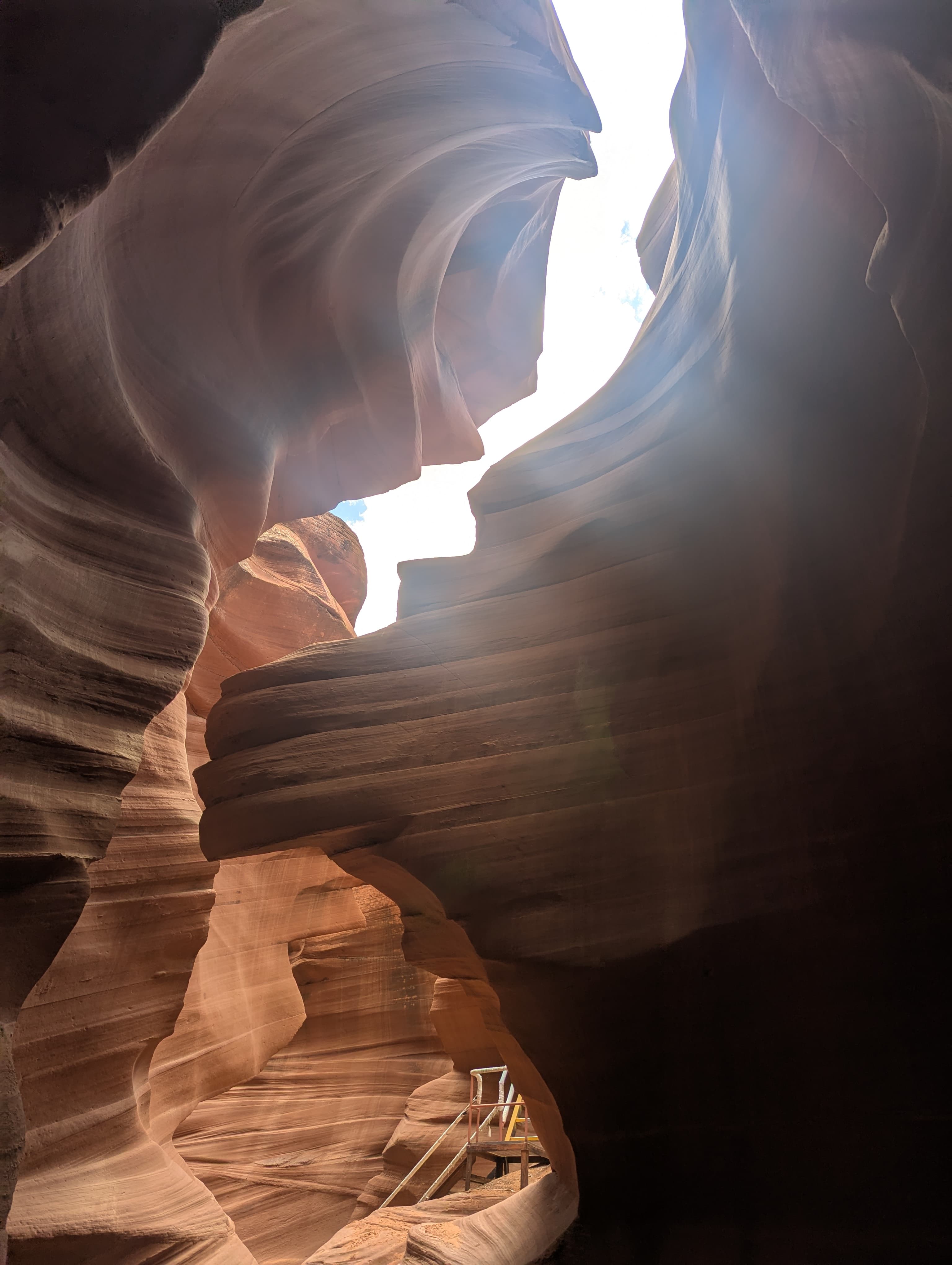
Canyon X: the quiet alternative
Canyon X is an exclusive Ken's Tours property: the only operator licensed to access it. The canyon is comparable in size and beauty to Upper Antelope, but tour groups are intentionally kept small. No large buses, no continuous rotation of crowds. Tripods are permitted. The access involves some light scrambling (hence the "moderate" rating) but nothing strenuous. At $79 per person, it is competitively priced and often has better availability on short notice when Upper Antelope is sold out weeks ahead. Full Canyon X guide here.
Mountain Sheep Canyon
Mountain Sheep Canyon is one of the lesser-known Navajo-guided slot canyons near Page, operated by Roger Ekis Antelope Canyon Tours. It is narrower than the Antelope canyons and sees significantly fewer visitors, which makes it appealing for those who want a genuine slot canyon experience without the crowds. Pricing is typically lower than Upper Antelope. It is not as well documented online as the major canyons, which is part of its appeal.
Waterholes Canyon: the self-guided option
Waterholes Canyon is located on City of Page land (not Navajo Nation), which means self-guided entry is permitted for a small fee: currently in the range of $10–20 per person. The canyon is shorter and less dramatic than the Antelope canyons, but it is the only slot canyon near Page where you can explore at your own pace without a guide. Flash flood risk is still real; check the forecast before entering. The canyon entrance is close to the Horseshoe Bend viewpoint, making it an easy addition to a Horseshoe Bend visit.
Utah Slot Canyons
The Utah canyons on this list are all within a day's drive of Page, AZ, and offer a different experience: self-guided access, more remote settings, and the feeling of being in the canyon alone rather than in a guided group. The tradeoff is more logistical preparation required (permits, gear, weather monitoring) and higher physical demands.
Wire Pass and Buckskin Gulch
Wire Pass is a short slot canyon (about 1.7 miles) that functions as the main access point for Buckskin Gulch. The trailhead is approximately 40 miles north of Page via US-89. Wire Pass itself offers classic slot canyon scenery (narrow walls, sandstone striations) in a manageable half-day hike. An NPS permit is required; prices are in the range of $10 per person.
Buckskin Gulch is a different scale entirely. At approximately 20 miles long, it is the longest slot canyon in the world. The entire route through the gulch (from Wire Pass to the Paria River confluence) requires a full day or overnight trip, with no practical exit points for most of the route. Flash flood risk is classified as extreme: the gulch can fill with water from storms 30+ miles away, and there is nowhere to go. Experienced slot canyon hikers who monitor weather carefully rate it as one of the most impressive canyon experiences in the Southwest.
Peek-a-Boo Slot Canyon (Kanab)
Not to be confused with Peek-a-Boo Gulch near Escalante, the Peek-a-Boo slot canyon near Kanab, Utah (also called Red Canyon Slot) is a BLM-managed canyon accessible via a permit that costs approximately $6 per person as of 2026. It is about 120 miles north of Page, roughly a 2-hour drive. The canyon is shorter and less intense than Buckskin, suitable for hikers comfortable with some scrambling and climbing moves at entry points.
Spooky Gulch
Spooky Gulch near Escalante, Utah, earns its name from the claustrophobic width: the canyon narrows to approximately 10 inches in its tightest sections. This is not an exaggeration: packs must be removed and held overhead, and larger-framed adults may not fit through. The canyon is free (Grand Staircase-Escalante National Monument, no permit required for day use), but it is about 120 miles from Page, a 2-hour drive on mostly dirt road. Photography options are extremely limited by the width. This is more of an adventure experience than a photography destination.
The Zion Narrows
The Zion Narrows is technically a river gorge carved by the Virgin River rather than a classic slot canyon, but it is often compared with slot canyons for its narrow walls and dramatic scenery. Located in Zion National Park (approximately 180 miles from Page), it requires wading through the river for most of the route. A permit is required for the top-down through-hike; the bottom-up route (starting at the Temple of Sinawava) is permit-free but ends when the canyon gets too deep to wade without gear. This is the most accessible of the Utah options for visitors who are already in the Zion area.
How to Choose the Right Slot Canyon
- You want the iconic light beam photos: Upper Antelope Canyon, March–October, tours that depart between 10am and 1pm. Book 2–4 weeks in advance for peak season.
- You want to take serious photos with a tripod: Canyon X via Taadidiin Tours offers a Photography Tour ($142) where tripods are permitted. Antelope Canyon Upper and Lower ban all tripods.
- You want fewer crowds: Canyon X is the quietest of the Page canyons. Mountain Sheep Canyon or Waterholes Canyon are also low-traffic options.
- You want to explore at your own pace: Waterholes Canyon (Page, self-guided) or Wire Pass / Buckskin Gulch (Utah, NPS permit). The Utah options require more preparation but offer complete independence.
- You are traveling with young children: Upper Antelope Canyon (flat, easy, guided) or Lower Antelope Canyon (guided, some ladders, manageable for kids 6+). Avoid Buckskin Gulch and Spooky Gulch entirely with children.
- You are on a tight budget: Waterholes Canyon (~$10–20 self-guided) or Spooky Gulch (free). Lower Antelope is slightly cheaper than Upper for a comparable guided experience.
- You want the most remote experience: Buckskin Gulch, but plan carefully, check forecasts, and go with an experienced group or guide.
Flash Flood Safety
Flash floods are the defining safety concern of slot canyon hiking. A brief, intense thunderstorm anywhere in a drainage basin (which can extend 30 miles or more from the canyon) can send a wall of water through a narrow slot canyon within minutes. The canyon walls that make these places beautiful also make escape nearly impossible once water enters.
On Navajo Nation canyons (Upper, Lower, Canyon X), guides are connected to a radio network monitoring weather across the region. Tours are suspended immediately when any risk is detected; this system has a strong safety record. Trust it: if a guide says the tour is cancelled due to weather, that decision is non-negotiable.
For self-guided canyons (Waterholes, Buckskin, Wire Pass), the responsibility is entirely yours. Before entering any slot canyon:
- Check the NPS or local forecast for the entire drainage basin, not just your immediate location. A clear sky at the trailhead is meaningless if there are storms 20 miles upstream.
- Check the flash flood forecast specifically: the NWS issues Flash Flood Watches and Warnings that cover slot canyon terrain.
- Do not enter if there is any threat. The risk is not proportional to how dark the sky looks from inside the canyon.
- Tell someone outside your group where you are going and when you expect to be out.
Planning your visit: All three main Page canyons (Upper Antelope, Lower Antelope, Canyon X) can be visited on consecutive days from a base in Page. The best hotels in Page, AZ are a short drive from all trailheads. Check the Page, AZ weather guide for seasonal conditions before booking.
Which slot canyon is best for photography?
Upper Antelope Canyon is the most famous for the iconic light beam photos, but tripods are banned and guides control the timing. Canyon X (Ken's Tours exclusive) offers a nearly identical experience with fewer crowds and more flexibility for photographers. Neither Upper nor Lower Antelope Canyon allows tripods. If pure photography freedom matters most, Buckskin Gulch in Utah (self-guided, tripods welcome) is unmatched in length and variety of formations.
Which slot canyon does not require a guide?
All slot canyons on Navajo Nation land (Upper Antelope, Lower Antelope, Canyon X, Mountain Sheep) require a licensed Navajo guide: no exceptions. Waterholes Canyon near Page is on City of Page land and allows self-guided entry with a small fee. In Utah, Buckskin Gulch and Wire Pass are NPS land with permit-only self-guided access. The Zion Narrows is also self-guided with a permit.
What is the difference between Upper and Lower Antelope Canyon?
Upper Antelope Canyon (Tsé-bighánílíní, "the place where water runs through rocks") is a flat, easy walk with no steps, accessible to all fitness levels. The famous light beam effect happens here from March to October around 10am–1pm. Lower Antelope Canyon (Hazdistazí, "spiral rock arches") requires descending and climbing ladders and has a more rugged feel. It tends to be slightly cheaper, allows tripods on certain tours, and has fewer visitors than Upper. Both are on Ken's Tours or Navajo-licensed operator land.
Which slot canyon is least crowded?
Canyon X is the least crowded of the Page-area slot canyons: it is an exclusive Ken's Tours property and tour groups are smaller. Mountain Sheep Canyon and Waterholes Canyon also see far fewer visitors than Upper or Lower. In Utah, Buckskin Gulch and Wire Pass are remote enough that you can walk for hours without seeing another person, though a permit is required.
Are slot canyons dangerous?
The primary risk is flash flooding. Slot canyons channel rainwater from miles of surrounding desert through a narrow corridor: a thunderstorm 20 miles away can send a wall of water through a canyon with no warning. On Navajo Nation, guides monitor weather and radio communications and will pull groups out immediately if there is any risk. Self-guided canyons in Utah (Buckskin Gulch, Wire Pass) require you to check flash flood forecasts yourself before entering; the NPS permit system includes a weather check. Never enter a slot canyon if storms are forecast anywhere in the drainage basin.
What is the best time of year to visit slot canyons in Arizona?
March through May (spring) and September through October (fall) are the best seasons: comfortable temperatures (70–85°F), lower crowds than summer, and good light conditions. The famous Upper Antelope light beams are strongest from late March through early October, peaking around the summer solstice. Summer (June–August) brings intense heat in Page (105°F+) and the highest flash flood risk of the year due to monsoon storms. Winter is quieter and cooler but the light beam effect in Upper Antelope is weaker.
How far are the Utah slot canyons from Page, Arizona?
Wire Pass and Buckskin Gulch trailheads are approximately 40 miles (64 km) from Page, AZ, about a 50-minute drive via US-89 North. The Peekaboo and Spooky Slot Canyons near Escalante, Utah, are further: about 120 miles (190 km) from Page, roughly a 2-hour drive. The Zion Narrows is approximately 180 miles (290 km) from Page, about a 2.5–3 hour drive.
What is the best slot canyon in Arizona?
Upper Antelope Canyon is the most famous slot canyon in Arizona (and the most photographed), but Lower Antelope Canyon is the better overall experience for most visitors. Lower is cheaper ($75–80 vs $90–120 for Upper), allows tripods, has smaller groups, and its spiraling formations are more complex. If you want the iconic vertical light beams, you need Upper Antelope (midday, late March–early October only). For photographers who want a slot canyon without crowds, Canyon X near Page is the quietest option. All three are on Navajo Nation land near Page, Arizona and require a guided tour. The only self-guided slot canyon near Page is Waterholes Canyon (~$10–20), which is shorter and less dramatic than the Antelope canyons.
Written by Diego Fresno, Travel writer and independent publisher specialising in the American Southwest. Latest research conducted on location in Page, Arizona during July 2025. Guides are verified quarterly — last review April 2026.. Verified quarterly: last review April 2026. About the author →