Best time
4:30–6:00 pm (Apr–Oct)
Winter window
3:00–4:30 pm (Nov–Mar)
Focal length
14–16mm full-frame / ultrawide phone
Tripods
Allowed (no restriction)
Drones
Banned: FAA + Navajo Nation
Entry fee
$10 per vehicle
Sunrise
River stays in shadow, skip for color shots
Astro season
May–September (new moon)
The one mistake everyone makes
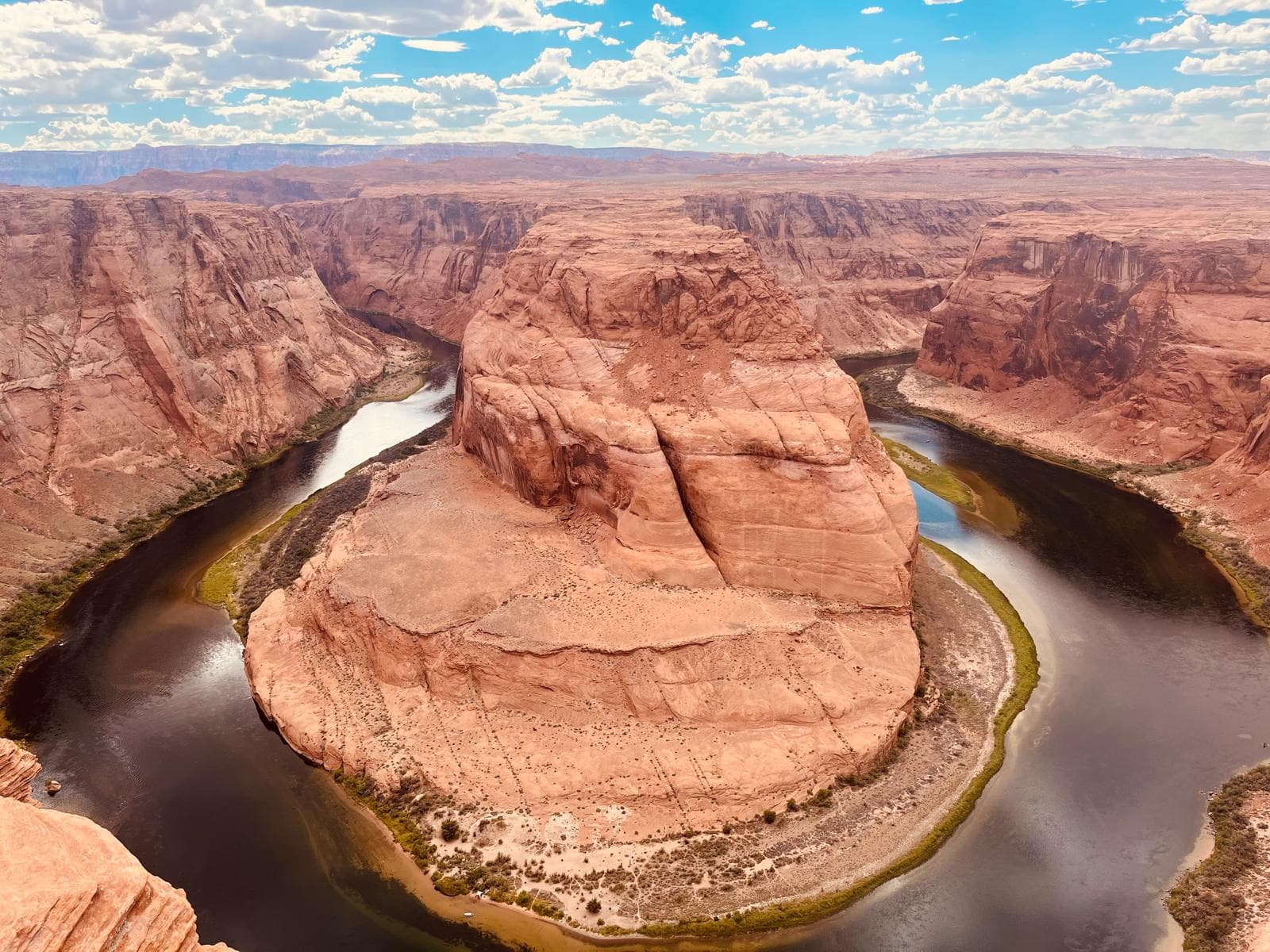
Horseshoe Bend is one of the most photographed locations in the American Southwest, and most of those photos look the same: a sharp cliff edge, a turquoise river far below, deep canyon walls catching warm afternoon light. The shots that do not look like that (the flat, grey, disappointing ones) almost always share a single cause: arriving at the wrong time of day.
The Colorado River at Horseshoe Bend sits roughly 1,000 feet below the rim, oriented so that direct sunlight reaches the water surface only in a narrow afternoon window. Before that window opens, the river sits in deep shadow. It does not matter how clear the sky is or how good your camera is: shadow is shadow. The entire photographic strategy for this location flows from understanding that constraint.
The afternoon-light window by month
The window exists because of the canyon's orientation relative to the sun's path. As the sun drops in the afternoon sky, its angle crosses a threshold where direct light reaches the river. That threshold shifts through the year as the sun's declination changes.
| Season | River-lit window | Light quality | Crowds |
|---|---|---|---|
| Summer (Jun–Aug) | 4:30 – 6:30 pm | Warm orange-copper | Peak |
| Spring (Mar–May) | 4:00 – 6:00 pm | Warm golden | High |
| Autumn (Sep–Oct) | 3:30 – 5:30 pm | Deep amber | Moderate |
| Winter (Nov–Feb) | 3:00 – 4:30 pm | Soft rose-pink | Low |
The practical implication: arrive 30 minutes before the window opens to find your position without competing with the crowd already shooting. The rim platform holds easily 100 people at once; arriving as the light hits means jostling for space.
The window does not end sharply; after the direct-river phase, the canyon walls hold warm rose-pink and amber tones for another 20–30 minutes as the sun dips behind the horizon. That post-sunset period is technically the worst time for the river color (the water reads flat), but some of the most dramatic cliff-wall shots come in those final minutes.
Sunrise at Horseshoe Bend: what you actually get
Horseshoe Bend faces roughly west. The sun rises in the east, behind the viewpoint. At sunrise, the cliff faces on the far side of the canyon catch first light, and the sky behind you turns orange and pink. The Colorado River, however, stays in deep shadow until the sun has climbed high enough to clear the canyon rim above the water, which does not happen during the typical sunrise window.
What you can shoot at sunrise that works:
- Blue hour compositions (20–30 minutes before civil twilight): long exposures at f/5.6 and ISO 800–1600 with a tripod capture the river in a deep slate-blue that reads as dramatic rather than shadowed.
- Dramatic sky compositions: if the eastern sky has cloud texture, the sunrise color behind you reflects off the upper canyon walls. The river color is irrelevant if the frame is mostly sky and rim.
- Silhouettes: shoot toward the southwest into the pre-dawn sky. Visitors on the rim read as clean silhouettes against a gradient sky.
Sunrise also gives you the easiest parking (the lot is 25–40% full before 7:00 am) and the fewest people on the rim. If getting empty-rim shots matters more than river color, that trade-off makes sense.
Camera settings that work
The core photographic challenge at Horseshoe Bend is extreme contrast: a bright sky and sunlit canyon walls sitting alongside shadowed cliff faces and (depending on timing) a lit or unlit river. The exposure gap is routinely 4–6 stops, well beyond what a single raw file can hold cleanly.
| Condition | Aperture | Shutter | ISO | Notes |
|---|---|---|---|---|
| Afternoon light (river lit) | f/8 | 1/200s | ISO 200 | Meter on canyon walls |
| Afternoon light (high contrast) | f/8 | Bracket ±2EV | ISO 100 | HDR merge in Lightroom |
| Golden hour (last 20 min) | f/5.6 | 1/100s | ISO 400 | Sandstone goes deep orange |
| Blue hour (after sunset) | f/5.6 | 4 – 15s | ISO 800 | Tripod required |
| Sunrise (pre-dawn) | f/4 | 25 – 60s | ISO 1600 | River in shadow, sky drama |
| Astrophotography | f/2.8 | 15 – 25s | ISO 3200–6400 | New moon, May–Sep |
Metering strategy
The default mistake is letting the camera meter on the sky or the bright canyon walls, both of which push the exposure down and leave the shadowed areas as pure black. Use spot metering on the canyon wall in mid-shadow, or matrix/evaluative metering and apply +1 to +1.5 EV of positive exposure compensation. Check the histogram: you want the main peak in the middle third, not pushed to the right edge.
Bracketing and HDR
Three-frame exposure bracketing at -2/0/+2 EV captures the full dynamic range in situations where a single frame cannot. Merge in Lightroom (Photo > Photo Merge > HDR) with Deghost set to None or Low; the Colorado River does not move fast enough to create ghosting artifacts. The resulting merge gives 10–12 stops of usable dynamic range, enough to hold both the sky and the shadowed river in a single image.
Phone photography
Modern flagship phones (iPhone 15 Pro, Pixel 8 Pro, Samsung S24 Ultra) handle Horseshoe Bend well in the afternoon-light window. Use the ultrawide (0.5×) lens to capture the full horseshoe arc. Shoot in ProRAW (iPhone) or RAW (Android) for editing flexibility. The HDR computational processing in auto mode usually handles the contrast well enough for social sharing; for print-quality output, manual RAW gives you more control. Do not use portrait mode or any AI enhancement that alters the landscape geometry.
Filters
A circular polarizer cuts atmospheric haze and can boost the turquoise saturation of the river, but works only when the sun is roughly 90 degrees to your lens axis, which during the afternoon window puts the polarizer at roughly peak effectiveness. Rotate until the river reads most saturated. ND filters are largely redundant during the light window (you are shooting at fast shutter speeds), but a 3-stop ND is useful for blue-hour long exposures if you want to smooth any wind-driven ripples on the water.
Composition: framing the bend
Focal length and the full arc
The horseshoe shape only reads as a complete arc at focal lengths below 20mm on full-frame. At 24mm you can frame either the left arm or the right arm of the bend, but not both from the standard rim position. If you only have a kit lens starting at 18mm, move back 5–10 meters from the safety fencing to include both arms, the extra distance at 18mm gives you marginally more coverage than standing at the rim at 24mm.
Centering versus rule of thirds
Both compositional approaches work but communicate differently. Centered placement of the bend creates symmetry and emphasizes the geometric perfection of the meander: this is the archetypal Horseshoe Bend shot. Placing the bend off-center (rule of thirds) introduces visual tension and foregrounds the rim edge, which adds scale. Try both; the centered version tends to perform better on social platforms while the off-center version reads better as a print.
Foreground interest
The red sandstone rim is the most reliable foreground element. Lying flat and shooting with the camera at ground level (2–5 cm from the rock surface) brings the textured sandstone into the foreground at hyperfocal distance, creating depth that the standard standing shot lacks. This low-angle technique requires a tripod or beanbag and works best in the final 30 minutes of the afternoon window when the foreground rock also catches warm light.
Avoiding other visitors in the frame
At peak summer hours (1:00–4:00 pm) the rim holds 200–300 people. Complete exclusion is not practical without long exposures that blur people into ghosts. Two realistic approaches: (a) arrive 15 minutes before the light window (around 4:15 pm) and position at the left or right extremes of the rim platform where fewer people stand, (b) use a faster shutter and clone-stamp in post. The 6:00–7:30 pm window after the light has faded is the least crowded period of the day for any style of shot where direct river light is not required.
Post-processing the extreme contrast
Single-raw workflow
Import into Lightroom or Capture One. Start by pushing Shadows to +60 to +80 and pulling Highlights to -50 to -70. This recovers the shadowed cliff faces without blowing the sky. Clarity at +15 to +25 adds microcontrast to the sandstone texture without the haloing of older HDR workflows. For the river: boost Vibrance (not Saturation) by +20 to preserve the natural teal-green without oversaturating. Color-grade using a slight orange push in the Midtones HSL panel to keep the sandstone warm.
HDR merge workflow
After merging (Lightroom: Photo Merge > HDR), the resulting DNG has far more recoverable range. Reduce Texture and Clarity slightly (-5 to -10) after merge to remove the HDR "plastic" look that automated merges can introduce. Focus local adjustments on the river (Radial Filter with Exposure +0.5 and Saturation +15) to make it pop relative to the walls without the composite reading as obviously processed.
Common processing mistakes
- Oversaturated orange: the sandstone reads warm but not fluorescent. Cap orange Saturation at +20; above that it looks fake.
- Halo artifacts: dark-light edge halos appear when Clarity or local Contrast are pushed too hard on high-contrast edges like the rim line. Use a feathered Radial Filter to apply contrast only within the canyon, not at the rim-sky boundary.
- Noise in shadow recovery: pushing Shadows above +80 in base ISO shots introduces luminance noise in the canyon depths. Apply Noise Reduction (Luminance 30–40) after your tonal adjustments, not before.
Tripods, drones and rules on the rim
Horseshoe Bend is managed by the City of Page, Arizona. As of 2026, there are no restrictions on tripods or monopods on the viewing platform; equipment can be set up freely on the rim. This is a meaningful difference from Antelope Canyon, where tripods have been banned by the Navajo-authorised operators since 2019.
Commercial photography (paid shoots for clients, wedding sessions, professional portrait work) may require a permit from the City of Page. Recreational and travel photography does not.
Drones are prohibited without exception. Horseshoe Bend sits within a FAA-designated restricted airspace, and the adjacent territory falls under Navajo Nation jurisdiction where recreational drones are separately banned. Both restrictions are actively enforced. There is no permit process available at this location.
Photo tours and guided sessions
No operator currently runs a dedicated photography workshop specifically at Horseshoe Bend, the rim is a public viewpoint that any visitor can access independently. The strongest option for photographer-oriented touring is a combo tour that pairs Upper Antelope Canyon (for the morning light-beam window) with Horseshoe Bend in the afternoon, hitting both locations at their optimal photography time in a single day.
Antelope Canyon & Horseshoe Bend, Full Day
Upper Antelope Canyon in the morning (light beams window) followed by Horseshoe Bend timed for the afternoon-light window. Small groups, Navajo-guided AC section, free cancellation.
Lower Antelope Canyon & Horseshoe Bend from Las Vegas
Full-day trip from Las Vegas covering Lower Antelope Canyon and Horseshoe Bend. Lower AC allows slightly more time than Upper for photography. Award-winning operator, 8,000+ reviews.
Frequently asked questions
What is the best time of day to photograph Horseshoe Bend?
4:30–6:00 pm in summer (April–October). That is the only window when the sun angle drops low enough to light the river directly. Before 4:00 pm the Colorado River sits in deep shadow regardless of weather. In winter (November–March) the window shifts to 3:00–4:30 pm. Arriving 30 minutes before the window starts lets you find a position without competing with others who are already shooting.
Can you use a tripod at Horseshoe Bend?
Yes. Unlike Antelope Canyon (where tripods have been banned since 2019 by the Navajo operators), Horseshoe Bend has no tripod restriction as of 2026. The rim is managed by the City of Page and no photography equipment permit is required. A tripod is useful for blue-hour shots after the light window ends but is largely redundant during the afternoon-light window, when 1/200s at ISO 200 gives a clean handheld exposure.
Is sunrise worth it at Horseshoe Bend for photography?
Only for specific shots. At sunrise the sun rises behind the viewpoint, which means the cliff face glows but the Colorado River stays in shadow, the opposite of what makes the classic shot iconic. Sunrise is worth it for: (a) dramatic sky compositions where the river color is irrelevant, (b) silhouette shots using other visitors or vegetation, and (c) long exposures in blue hour immediately before civil twilight. If you want the turquoise-river shot, come in the afternoon.
What camera settings work best at Horseshoe Bend?
In the afternoon-light window: f/8, 1/200s, ISO 200 as a starting point. Meter on the shadowed canyon walls, not the sky. If the river still clips to blown-out white, bracket 3 frames (-2/0/+2 EV) and merge HDR in post. For focal length: 14–16mm full-frame, 10–12mm APS-C, or the ultrawide (0.5×) on modern phones. Avoid zooming in: the bend needs the wide field to read as a complete horseshoe shape.
Can you photograph Horseshoe Bend without crowds?
In practice, no: completely empty shots require either very early blue hour (pre-civil-twilight) or long exposures that blur moving people. The most manageable windows are: (a) 5:30–7:30 am: fewer people but flat light on the river, (b) after 6:30 pm in summer: crowd thins dramatically as the light window ends. Composition can also help: a low angle emphasizing the canyon walls over the rim reduces how many other visitors appear in frame.
What lens is best for Horseshoe Bend?
14–16mm on full-frame (or equivalent). The classic shot requires capturing the full horseshoe curve; at 24mm you will crop the left or right arm of the bend depending on where you stand. If you only have a kit lens starting at 18mm, move back toward the edge of the rim platform to include both arms. Telephoto shots zooming into the canyon walls or river details are a strong secondary option that requires no special timing.
Are drones allowed at Horseshoe Bend?
No. Horseshoe Bend sits within a FAA-designated Temporary Flight Restriction zone and also borders Navajo Nation airspace. Drones are prohibited and are confiscated on sight. This applies to all recreational and commercial operators. No permit process exists to override this restriction at this location.
Is Horseshoe Bend good for astrophotography?
Yes: the rim is accessible 24 hours and the area has low light pollution compared to urban areas. The Colorado River curves into a natural foreground element that works well with the Milky Way arch. The best season for Milky Way core is May–September around new moon. A tripod and a wide-angle f/2.8 lens at ISO 3200–6400 with 15–25 second exposures are the standard starting point. The main challenge is managing the temperature drop after dark and coordinating parking arrival.
Written by Diego Fresno, Travel writer and independent publisher specialising in the American Southwest. Latest research conducted on location in Page, Arizona during July 2025. Guides are verified quarterly — last review April 2026.. Verified quarterly: last review April 2026. About the author →
Related guides
Best time to visit Horseshoe Bend: month-by-month guide
Crowds, temperature, and light windows by season, and why the afternoon slot beats sunrise every time.
Read more →Horseshoe Bend parking guide: fee, hours and overflow tips
When the lot fills, how early to arrive by season, and the arrival windows that give you easy parking and good light.
Read more →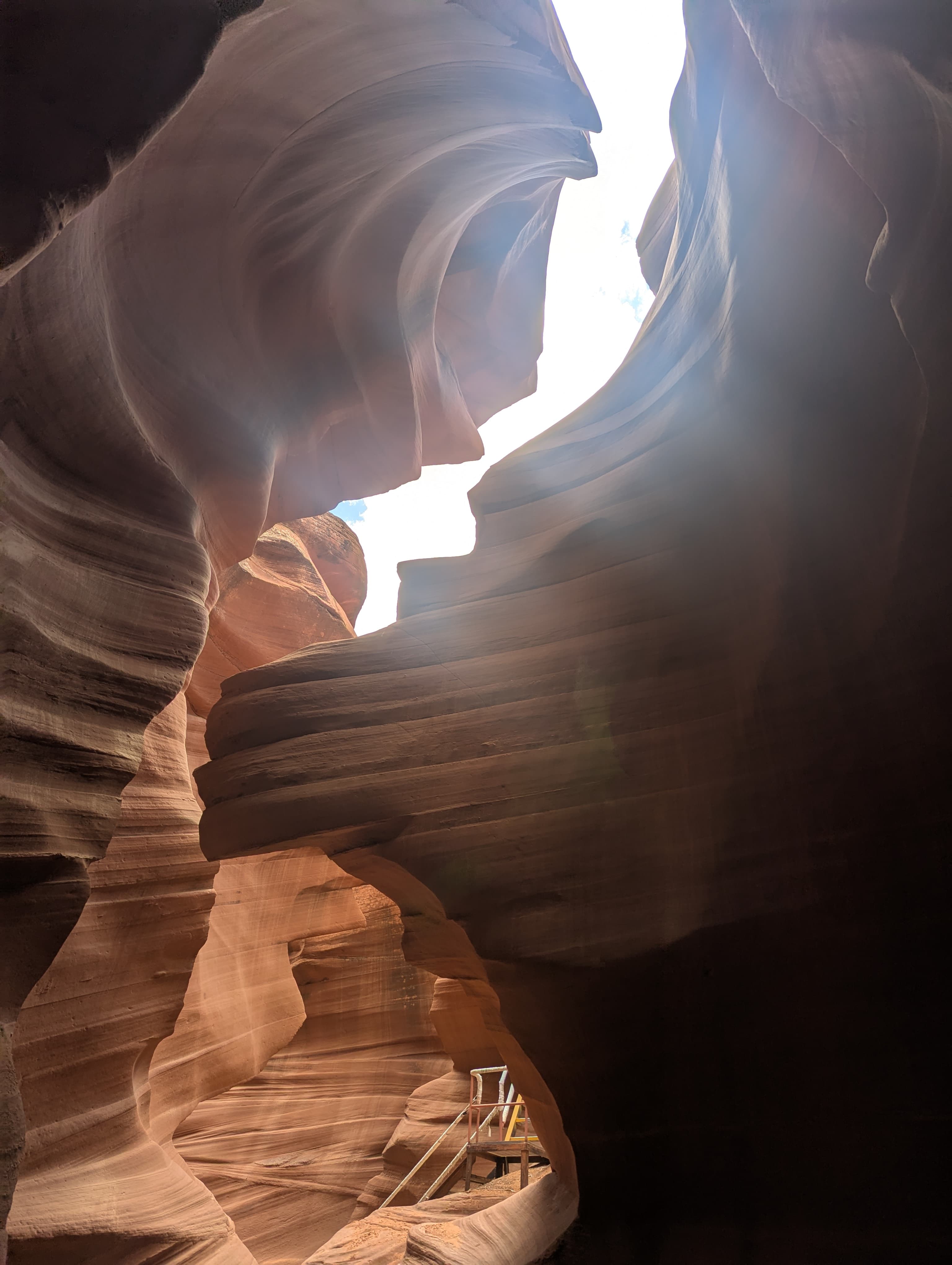
Antelope Canyon photography guide: post-ban settings and tips
Tripods banned since 2019: here are the handheld phone and DSLR settings that still produce great results.
Read more →