Valley of the Gods is a remote sandstone landscape in San Juan County, Utah, where hundreds of towering buttes and spires rise from the high desert plains of the Bears Ears region, free to visit and almost always uncrowded. The formations are geologically identical to those at Monument Valley (30 minutes south), but the experience is completely different: no entry fee, no tour buses, no infrastructure, just open desert on a 17-mile dirt loop. For photographers and road-trippers who want the Monument Valley look without the crowds or cost, this is the correct answer.
Location
San Juan County, Utah
Entry fee
Free
Permit
Not required
Scenic loop
17 miles (unpaved)
Vehicle
Regular cars OK in dry conditions
From Mexican Hat, UT
12 miles / 20 min
From Monument Valley
20 miles / 30 min
From Bluff, UT
22 miles / 35 min
Facilities
None (no water, no toilets)
What is Valley of the Gods?
Valley of the Gods is a broad desert basin in San Juan County, southeastern Utah, dotted with hundreds of freestanding sandstone formations ranging from squat boulders to monoliths rising 400 feet from the valley floor. The BLM administers the area as part of Bears Ears National Monument, which means the land is federally managed public land with no entry controls, no fees, and no visitor caps.
The geology is Permian-era Cedar Mesa sandstone, the same formation that created the buttes and spires of Monument Valley. The difference is erosion pattern and mineral chemistry. Valley of the Gods formations tend to be more isolated and varied in shape than Monument Valley's iconic symmetrical buttes; the valley reads less like a stage set and more like a natural sculpture garden scattered across 30 square miles of open range.
Historically, the area was part of the territory of the Ancestral Puebloans, and artifacts and ruins are scattered throughout the Bears Ears region. Do not disturb or remove anything you find.
Valley of the Gods vs Monument Valley
Most visitors to this part of Utah are choosing between the two, combining them, or arriving at one by accident on the way to the other. The comparison is worth laying out honestly.
| Valley of the Gods | Monument Valley | |
|---|---|---|
| Entry fee | Free | $10/person + $15/vehicle |
| Permit | Not required | Not required (for Valley Drive) |
| Managed by | BLM (Bears Ears NM) | Navajo Nation |
| Main road | 17-mile unpaved loop (CR 242) | 17-mile unpaved loop (Valley Drive) |
| Vehicle needed | Standard car (dry conditions) | Standard car (Valley Drive) |
| Crowds | Very low | High (600K+ visitors/year) |
| Guided tours | Not available (self-drive only) | Required for restricted areas |
| Facilities | None | Visitor center, restaurant, gift shop |
The honest verdict: Monument Valley is more iconic and better-known for good reason. The formations are large and symmetrical in a way that photographs extremely well, and the Navajo guides add genuine historical context that you cannot get on your own. Valley of the Gods is better for those who want solitude, do not want to pay entry, or are already in the area and want to add a half-day excursion that most tourists skip.
Many road-trippers do both in a single day: Valley of the Gods in the morning (catching the eastern formations in early light), then drive south to Monument Valley for the afternoon sunset on The Mittens.
Driving the scenic loop
The main road through Valley of the Gods is County Road 242, an unpaved 17-mile loop through the heart of the formation area. Both ends of the loop connect to US Highway 163.
Most visitors enter from the western end (near Bluff) and drive east toward Mexican Hat. This direction puts the most photogenic formations ahead of you rather than behind, and the light in the morning comes from the east, which means east-facing buttes pick up warm golden light as you drive toward them. If you are visiting in the afternoon, the reverse direction works better: enter from the Mexican Hat end and drive west, so you face the formations as the sun drops behind them.
Speed limit on the unpaved road is typically 15 to 25 mph, and the surface conditions set the practical upper limit. In dry summer conditions, the road is well-graded and vehicles move comfortably. After any precipitation, drop any plans to drive it.
Typical time for the loop including photography stops: 2 to 3 hours. Driving straight through without stops: about 60 to 75 minutes.
Named formations to look for
Most formations are not marked by signs, so having a map or audio guide loaded before you leave the highway is useful. These are the main named landmarks along the loop:
- Seven Sailors: a cluster of seven tall, narrow spires in the central section of the loop. The most distinctive and most-photographed grouping in the valley.
- Setting Hen Butte: a broad, flat-topped mesa in the eastern section with a profile said to resemble a brooding hen. One of the largest formations visible from the road.
- Battleship Rock: a long, narrow butte with a silhouette that does resemble the profile of a naval vessel, particularly when viewed from the west in late afternoon light.
- Franklin D. Roosevelt Butte: a formation in the western section said to have a profile resembling FDR when viewed from a specific angle.
- Lady in a Tub and Rooster Butte: smaller formations near the Mexican Hat end of the loop.
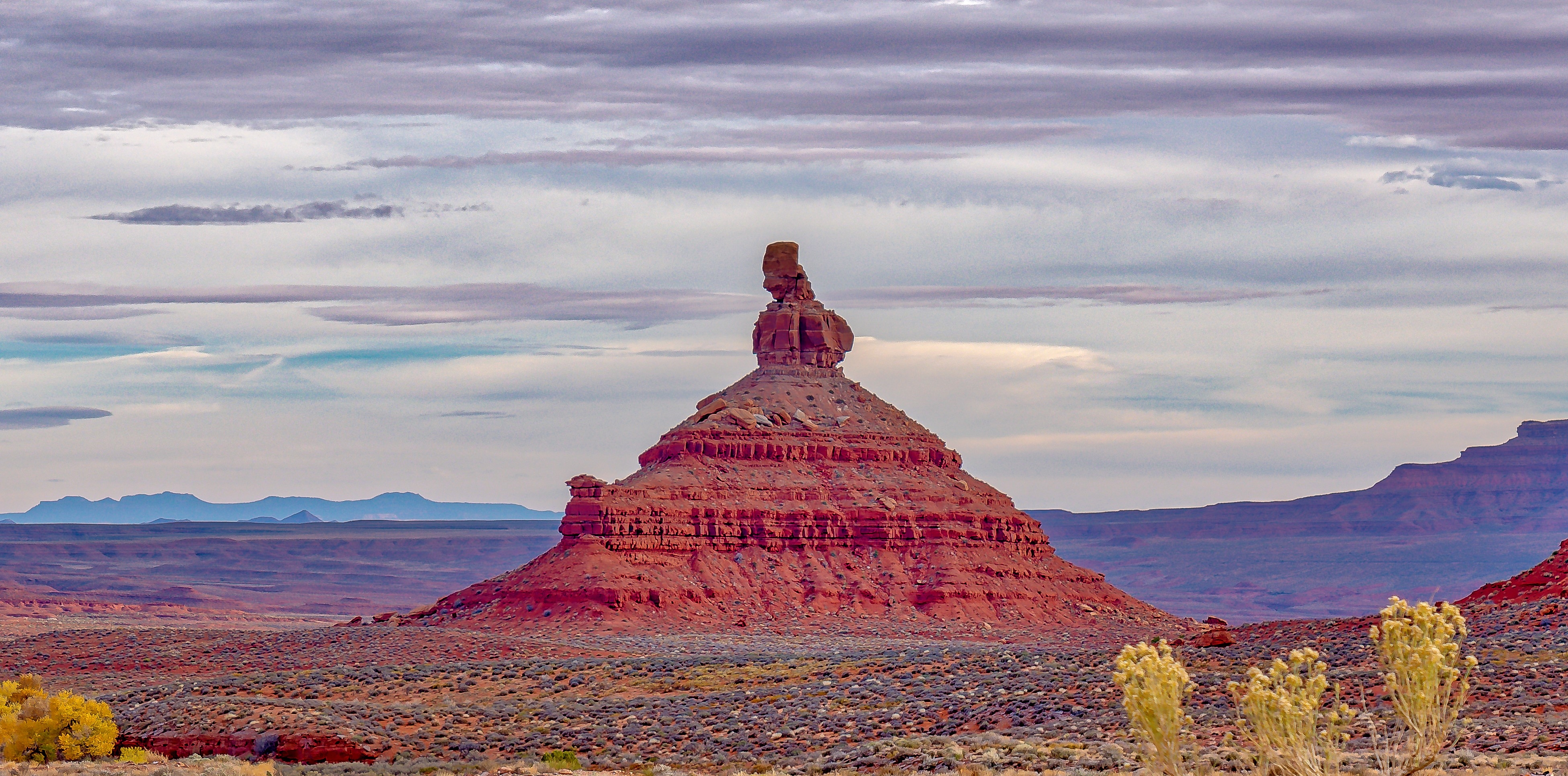
A self-guided audio tour (details in the Tours section) provides GPS-triggered commentary at each formation and helps identify landmarks that are otherwise easy to miss without a local reference point.
How to get there
Valley of the Gods is accessed from US Highway 163, which runs between Bluff, Utah and Mexican Hat, Utah. There are two entrances to the loop, both on US-163.
West entrance (from Bluff)
From Bluff, drive east on US-163 approximately 12 miles. Watch for a dirt road branching north (left) from the highway. There is a small Valley of the Gods marker at the junction. This is the western terminus of CR 242.
GPS for west entrance: approximately 37.1595°N, 109.9998°W
East entrance (near Mexican Hat)
From Mexican Hat, drive west on US-163 approximately 4 miles. The CR 242 junction is on the north (right) side of the highway.
GPS for east entrance: approximately 37.1756°N, 109.8671°W
Download offline maps before leaving. Cell coverage is unreliable once you leave US-163 and disappears completely in the middle of the loop. Google Maps, Gaia GPS, and the Avenza Maps app all allow offline map downloads that work without a cell signal.
From major nearby cities
- From Moab, UT: approximately 115 miles south via US-191 and US-163, about 2 hours
- From Monument Valley Visitor Center: approximately 20 miles north on US-163, about 30 minutes
- From Page, AZ: approximately 100 miles west via US-89 and US-163, about 1 hour 45 minutes
- From Bluff, UT: approximately 22 miles east on US-163, about 35 minutes
Vehicle requirements
In dry conditions, Valley of the Gods Road is passable by most standard passenger vehicles. This distinguishes it from destinations like White Pocket or Coyote Buttes, where true 4WD with high clearance is non-negotiable.
That said, the road has variable quality. Sections can be washboarded, rutted by truck traffic, or rough from erosion, which a low-clearance sedan will feel intensely and which can occasionally damage undercarriages. A crossover SUV (Toyota RAV4, Subaru Outback, Honda CR-V, even with standard clearance) is more comfortable and gives more room for error. If you are in a rental car, check the rental agreement: most prohibit off-pavement driving and this road technically qualifies.
The weather rule is absolute: if it has rained within the last 24 hours, or if there is any chance of rain during your visit, do not drive the loop. The clay-heavy surface absorbs water and becomes frictionless mud that strands vehicles regardless of drivetrain. Even 4WD trucks get stuck on wet Valley of the Gods road. Check the weather in Bluff and Mexican Hat before you go.
Entry fee and permit
There is no entry fee and no permit required. Valley of the Gods is BLM-managed land within Bears Ears National Monument and is open to all visitors year-round at no cost. There is no staffed entrance, no fee station, and no visitor reservation system.
This contrasts with Monument Valley (Navajo Tribal Park, $10/person plus $15/vehicle), Arches National Park ($35/vehicle, timed entry required in peak season), and most other major Southwest destinations.
Best time to visit
Spring (March to May) and fall (September to November) offer the most comfortable conditions for driving and exploring. Temperatures in those windows typically run between 55 and 85°F (13 to 30°C), the road is stable in dry weather, and the light at sunrise and sunset is exceptional on the red sandstone.
| Season | Temps | Road | Verdict |
|---|---|---|---|
| Spring (Mar-May) | 50-80°F (10-27°C) | Good if dry; mud risk early March | Best overall |
| Summer (Jun-Aug) | 90-108°F (32-42°C) | Firm and fast when dry; monsoon risk Jul-Sep | Start before 8am; avoid July monsoon |
| Fall (Sep-Nov) | 45-80°F (7-27°C) | Usually excellent after monsoon ends | Excellent, fewer visitors than spring |
| Winter (Dec-Feb) | 20-50°F (-7-10°C) | Ice risk; impassable in snow | Dramatic light, almost no visitors |
Summer caution: temperatures regularly exceed 100°F (38°C) and the Arizona monsoon (July through early September) generates afternoon thunderstorms that can soak the road within minutes. If you visit in July or August, start early (before 8am), carry significantly more water than you think you need, and monitor the weather forecast carefully.
Photography note: the best light comes in the first 90 minutes after sunrise (golden light catching the east faces of the buttes) and the last 90 minutes before sunset (warm amber light from the west, long shadows deepening the valley). Midday light is harsh and flat.
Tours
Valley of the Gods is primarily a self-drive destination. No guided jeep tour or in-person guided experience currently operates within the valley itself.
One option available through Viator is a self-guided audio driving tour, which provides GPS-triggered commentary as you navigate the loop. For those new to the area or wanting geological and historical context on each formation, it adds meaningful depth to the drive.
Valley of the Gods Scenic Loop: Self-Guided Audio Tour
GPS-triggered audio commentary narrated as you drive the 17-mile loop. The tour explains the geology of each named formation (Seven Sailors, Battleship Rock, Setting Hen) and the cultural history of the Bears Ears region. Works on any smartphone. Duration: 2 to 3 hours. No guide required.
If you are combining Valley of the Gods with Monument Valley on the same day, the Monument Valley jeep tours add guided access to restricted areas inside the Tribal Park (Mystery Valley, Hunt's Mesa) that are not accessible on the self-drive Valley Drive.
Monument Valley Scenic Express Safari (3 Hours)
Half-day Navajo-guided jeep tour departing from Monument Valley Visitor Center. Covers John Ford Point, The Mittens, Merrick Butte, and areas of the Tribal Park not accessible by the self-drive Valley Drive. Combines naturally with Valley of the Gods in the morning of the same day.
Where to stay nearby
There is no accommodation inside Valley of the Gods (other than the B&B covered in the next section). The practical bases are Mexican Hat and Bluff.
Mexican Hat, UT (12 miles)
The closest town to the valley, named for a nearby mushroom-shaped rock formation visible from the highway. Mexican Hat is very small (population under 100) and has two accommodation options: the Mexican Hat Lodge and theSan Juan Inn. Both are basic motels on US-163 with limited services. The San Juan Inn has a small restaurant and sits directly on the San Juan River. Rates are typically $85 to $130 per night.
Mexican Hat is the right base if your primary goal is Valley of the Gods combined with Monument Valley. You are 20 minutes from the Tribal Park and right at the eastern entrance of the Valley of the Gods loop.
Bluff, UT (22 miles)
A more developed small town with a better selection of accommodation and restaurants. Notable options include the Recapture Lodge, Desert Rose Inn, and the Cow Canyon Trading Post (which serves meals). Rates range from about $90 to $180 per night.
Bluff works as a base if you are combining Valley of the Gods with Bears Ears sites, Cedar Mesa, Hovenweep National Monument, or other southeastern Utah destinations north of the valley.
Monument Valley area (30 min south)
If you are spending multiple days in the area, the Monument Valley hotels give you sunrise and sunset access to The Mittens and are only 30 minutes from Valley of the Gods. The View Hotel is inside the Tribal Park. Goulding's Lodge is just outside the park boundary with its own tour operation.
Valley of the Gods Bed and Breakfast
The Valley of the Gods Bed and Breakfast is a converted 1930s homestead sitting on 160 acres of BLM land directly inside the valley, surrounded by the named formations. It operates entirely on solar power. There is no cell signal, no television, and no internet connection on the property.
From the property you look directly at Seven Sailors and other buttes. Sunrise and sunset from the porch are genuinely extraordinary. The B&B runs as a working operation with a small number of rooms, and the hosts provide breakfast.
This is not a luxury property in the conventional sense. The remoteness and off-grid nature are the point, not a limitation. Rates are approximately $165 to $225 per night including breakfast. Book several months in advance for spring and fall dates. Search for Valley of the Gods Bed and Breakfast to find the property directly.
For context, the B&B appears in search data with nearly 900 monthly searches by name, which signals strong discovery intent among visitors researching the area. It is not a secret; it has genuine fans who book it year after year.
Photography tips
Valley of the Gods rewards photographers who plan around the light.
Sunrise and the first 90 minutes: the east-facing sides of the buttes catch warm golden light immediately after sunrise. Driving the loop from the western (Bluff) entrance means you face east-facing formations as you drive east, which works perfectly for morning light. The road surface also tends to be firmer in the morning before any daytime heat sets in.
Sunset and the last 90 minutes: enter from the Mexican Hat end and drive west to face the formations as they pick up amber light from the setting sun. The long shadows in late afternoon add depth and texture to buttes that look flat in midday light.
Lens choices: a wide-angle zoom (16-35mm equivalent) covers the open desert context and captures multiple formations in a single frame. For isolated buttes, a 50-85mm range compresses the background and gives a more monumental look to individual formations.
Night photography and Milky Way: Valley of the Gods is in one of the darkest areas of Utah. The nearest significant light source is Bluff, 22 miles away, and even that is a very small town. On a clear, moonless night, Milky Way photography from inside the valley is excellent. The B&B or dispersed camping are the only ways to be on site at night.
Drones: BLM rules apply to Valley of the Gods. As of 2026, there is no blanket drone prohibition here (unlike NPS units), but BLM regulations require that drones not create a hazard or interfere with other visitors. Check current BLM regulations before flying.
Is Valley of the Gods worth visiting?
Yes, especially for road-trippers combining it with Monument Valley or Bears Ears. The landscape is visually on par with Monument Valley, the access is completely free, and the crowds are a fraction of what you find at the Navajo Tribal Park. The 17-mile loop takes 2 to 3 hours and requires no special vehicle in dry conditions. The main reason to skip it would be a very tight schedule or wet roads, which turn the surface to impassable clay.
Do you need a permit to visit Valley of the Gods?
No. Valley of the Gods is BLM-managed public land and is free and open year-round with no permit, no reservation, and no fee of any kind. There is no visitor cap or staffed entrance station.
What kind of vehicle do you need for Valley of the Gods?
In dry conditions, most standard passenger cars can complete the loop, though a crossover or SUV with moderate clearance is more comfortable. The road surface is packed gravel and hardpacked dirt, not deep sand. The critical rule is weather: if it has rained recently or rain is forecast, do not enter. The clay surface becomes completely impassable when wet and will strand any vehicle, including 4WD trucks.
How long does it take to drive the Valley of the Gods loop?
Allow 2 to 3 hours minimum. The road is 17 miles and the surface limits comfortable speeds to 20 to 25 mph. Most visitors stop frequently for photographs and short walks around the base of formations. If you are driving through without stopping, about 1 hour. If you are photographing seriously, budget 3 to 4 hours.
How far is Valley of the Gods from Monument Valley?
About 20 miles and 30 minutes by road. From the east entrance of Valley of the Gods near Mexican Hat, drive south on US-163 into Arizona and continue to the Monument Valley visitor center. The two destinations combine naturally into a single day: Valley of the Gods in the morning, Monument Valley in the afternoon for the sunset light on The Mittens.
Can you camp in Valley of the Gods?
Yes. Dispersed camping is permitted on BLM land throughout the valley at no cost and with no permit required. There are no developed sites, water, or toilet facilities. The standard BLM leave-no-trace rules apply: human waste must be buried at least 6 inches deep, 200 feet from any water source, and all trash must be packed out. The dark-sky conditions here are outstanding.
Is Valley of the Gods the same as Monument Valley?
They are geologically similar (both feature sandstone buttes rising from a red desert plateau) but are separate places with very different visitor experiences. Monument Valley is on the Utah-Arizona border and is operated by the Navajo Nation, which charges $10 per person plus $15 per vehicle. Valley of the Gods is entirely in Utah, managed by the BLM, and is free. Monument Valley gets roughly 600,000 visitors per year; Valley of the Gods sees a small fraction of that traffic.
What is the Valley of the Gods Bed and Breakfast?
A converted 1930s homestead sitting on 160 acres inside the valley, surrounded by the named formations. It runs off solar power with no phone signal or television. Guests get sunrise and sunset views of the buttes from the property. Rates are approximately $165 to $225 per night including breakfast. It is one of the most remote and visually distinctive bed and breakfast properties in the American Southwest. Book months in advance for spring and fall.
Is Valley of the Gods open in winter?
Yes, the valley is open year-round. Winter brings fewer visitors and low golden light that works well for photography. The risk is weather: cold temperatures and occasional ice or snow can make the unpaved road treacherous, and any precipitation turns the clay surface into mud regardless of season. Check road conditions before visiting between November and March.
Written by Diego Fresno, Travel writer and independent publisher specialising in the American Southwest. Latest research conducted on location in Page, Arizona during July 2025. Guides are verified quarterly; last review April 2026.. Verified quarterly: last review April 2026. About the author →